Copyright © 2012 SlideWright Weblog. All Rights Reserved. Snowblind by Themes by bavotasan.com. Powered by WordPress.
Author Archive
You no longer have to bend the daylights out of your Look Pivot or Rossignol FKS brakes to ‘sort of’ fit your fat planks. Look is producing replacement Super Wide brakes (115-130mm) along with 72mm, 80-95mm and 100-115mm brake options for the forthcoming season. They come with the heel bases and forward pressure threaded tubes (which need to be removed). For some reason, these are supplied and NOT mounting screws. Apparently, the Super Wide brakes will also be available with Pivot 18′s
You can either use the base and brakes with existing binding spring assemblies by unscrewing the supplied forward pressure tubes and then CAREFULLY screw on the existing tubes and heel piece. Due to the angles of the tubes and threaded wire/rods, it is possible to cross thread them, so take your time, especially if you plan on swapping them between other skis with various heel bases and brakes.
It’s possible to mount multiple Pivot/FKS heel bases directly to your skis with alpine binding screws or in stainless steel inserts and machine screws. Using inserts for the toes, you can then utilize one set of bindings and multiple heel bases with desired brake widths.
Note: Look is not giving these away, so carefully consider your needs before moving forward with new heel bases and brakes.
Continue Reading »
SlideWright’s new Facebook page. Please ‘Like Us’ and check out 20% Coupon code.
The most noteworthy recent additions, changes and news include:
Just a quick note that we have re-established our FaceBook page with our new proprietary URL: http://www.facebook.com/SlideWright . Please check it out, ‘Like Us’ and provide comments, suggestions on enhancements and content.
After a ‘strange winter’, hopefully not to be repeated, we are in the transition spring where the weather is uncertain and all outdoor activities are an an option. Should you bike, ski/board, hike, run a river, go camping, etc, keep things hectic. Be sure to check out our Bike Tools to get and keep your bicycles in top performance shape for the ridng season. Also, there are great deals on Ski & Snowboard Tools and Supplies to round out your tuning set ups or get one going for next season.
Here is our list of Sale and Clearance Items ranging from 10 to 60% off!
Evernew Update: Since last year’s Japanese Tsunami, Evernew Trekking has been working hard to re-establish their manufacturing and supply system. For those waiting for Evernew products to become available, they are due any moment. The latest word was that they are at our shores, but going through the stringent customs process in California. Keep checking back. For those who have signed up for email notifications, we will let you know the moment we know when we will recieve our order or it is shipped. Sorry for any inconveniences this may have caused.
Please let us know if there you have questions or know of products that could be a good fit to our store, so we can offer you and others more options!
Best regards and Thanks for your support!
Terry Ackerman
SlideWright LLC
Along with Tips, News & Techniques, past Newsletters can be found in our Weblog
Continue Reading »
One of the few things consistent between all of the various shapes, sizes, side wall and top sheet shapes, binding locations, and camber/rocker, etc of skis and snowboards is that they are symmetrical relative to their longitudinal centerline.
Finding the centerline with accurate measuring and layout tools is critical when drilling for and mounting bindings or checking their proper mount locations from the shop. Not only for side to side symmetry, but to assure they are in line with the ski.There are many simple and complex tools and approaches employed using any number of measuring and layout tools to determine the centerline. Some are accurate and some are not.
The first two thing to remember is that in order for your skis to perform as designed is that bindings need to be centered relative to the edges and NOT the top sheet or side walls AND the sides of skis are typically not straight, but curved. Additionally, their proper fore and aft location is important and establishing an accurate centerline assists in this regard.
Cautions: Without factoring the curvature of the ski sides, simply using a try square or intersecting diagonals or intersecting arcs can result in minor to major inaccuracies.
Granted, the turning radii of many skis is large enough that measuring from both sides using a square can be reasonably accurate if not used absolutely and directly across the skis,
while using crossing diagonals and arcs can result in large discrepancies. Top sheet graphics and variable side wall shapes are other sources of inaccuracies. Whether a skis is cap or sandwich construction or symmetrical top sheet graphics, they are not to be relied on for measuring the skis other than general dimensions.This leaves the edges as the ’benchmark’ for the lateral ski dimensions (as well as for base flatness). Accurate measuring tools like calipers, tape measures and rulers can easily find the width from edge to edge, but are not necessarily the easiest or accurate or reliable tools at transferring measurements to the top sheet for marking.
Easy & Accurate Techniques: A very useful aid is to place a strip of masking tape down the perceived center of the ski. If you don’t have tape a grease pencil on the top sheet works as does a clamped piece of string or straight edge. The longer the straight edge or distance from your end marks, the more aligned your centerline will be. If the marks are closer and you are slightly off center with one of your marks, the angle of the centerline will be greater than if they same two marks are farther apart.
A center rule, ideally with edge guides or ‘locators’ is the simplest and quickest reliably accurate method to mark a center line. The math is eliminated and you simply need to match the measurements on each side of center to set the center.
This PDF centering template can be used to by folding it over the ski and creasing it over the edges at the same measurement and tape it. You can mark each end and then move the template other locations and use it on the other ski.
Using the common try or double square, is another easy option for finding center. Rather than spending time micro-tuning the blade location (with the handle against each edge) go ahead and ballpark the length either
just long or just short of center and make a mark along the end of the blade. After you have two marks, measure in between them to find true center.
Always double check your measurements, before, during and after drawing your centerline.
Once you are confident your line is indeed the center of your skis, you can square against it at the ski’s mounting point to draw your center line for your boot center and tap on your binding template and are ready to mark and drill for an accurate binding mount.
Continue Reading »A very useful resource for DIY binding mounting and comparisons is paper (or transparency) binding templates. Not only are they great aids for accurately laying out binding holes for drilling new holes, but you can also use them to compare existing hole clearances relative to new bindings, binding combinations and discovering unknown original bindings by the hole patterns on used skis.
Template Sources: Binding manufacturers often include templates in the box with new bindings (middle in image below).
Binding Freedom , the maker of stainless steel binding inserts has created a growing library of alpine and AT templates. (Bottom) Another insert manufacturer, Quiver Killer also is creating a template library (which may be edited versions of the Binding Freedom templates) along with other fastener downloads.
You can also draw your own (top). like we did with our CAD software, from a scan of the FKS/Pivot template provided by Look. It can be reprinted for multiple mounts and customized for different Boot Sole Lengths before printing.
Printing & Scaling: Accuracy is very important and the first step to verify printed templates is to check their relative scale and see how the actual bindings sit on the template to visually see if the holes align.
Check to see if the template has any scale or a dimension you can check with a ruler. Often the output from a printer can be slightly off for a variety of reasons. Scaling and reprinting may be necessary multiple times until you get it just right. If you cannot adjust the printing scale with your operating system or printing software, you may need to incorporate the use of graphics software that allows you to resize images and PDFs as needed before printing.
In the example above, the original print was off (too big) by 1mm in 200mm, or 0.5%. Since we needed to decrease the size of the print, we scaled the image 99.5% (199mm/200mm) to get the accurate result. If we needed to increase the output the same 0.5%, then we would need to set the printing scale at 100.5% (200mm/199mm).
For many the 0.5% discrepancy may be just fine, but if there are several layout, drilling and mounting steps off by 0.5% each, it’s possible to be off by a couple millimeters. On the other hand, sometimes minute errors cancel each other out and you can end up with dead on results despite the relative inaccuracies and many bindings do have built in adjustability. Regardless, it is best to be as accurate (especially for AT tech bindings) as you can with each step while also realizing this is not heart surgery and that these tolerances may actually be tighter than some shops and their binding mount jigs.
Splicing & Assembly: Because most bindings require variable Toe versus Heel piece locations due to variable foot and Boot Sole Length (BSL) AND the common printing length of 11 inches, usually two sheets are required per binding. As long as you locate each binding piece relative to the ski centerline and recommended or desired ski mount point and midsole boot mark, they can be utilized individually.
If you prefer to create one paper template per binding, you will need to print on a larger format printer or splice typical letter size sheets. Due to physical printer limitations, printing cannot occur to the paper edges. When two pieces need to be spliced, one piece will ideally need to be cut at the joint to assure accuracy during splicing (clear output does not need to be cut, unless desired).
Once one side is accurately cut, place it over the bottom sheet and a straight edge located along the center line. Align one edge and tape near the joint with masking tape to hold it close and still act as a hinge. Then align the other edge and the centerline of both sheets along the straight edge. Once this is correct, tape the other edge outside the center of the template.
Double check the joint and the straightness of the centerline. If you can measure any components between the two halves, do so to verify accuracy. One thing we add on out templates isdimensions that we can measure to double and triple check physical and relative dimensions. After you feel certain the two halves are where they need to be, run a strip of clear tape over the joint on the front and then the backside.
Repeat on another pair if desired for one template per ski and cut off excess paper on the sides and ends. The masking tape will be removed in the process. The template(s) are now ready to be taped onto the ski centerline and mounting point at the boot mark.
Ski Centerline and Boot Sole Length and Mid Sole: As alluded to above, the binding mounting templates are relative to the centerline of the bindings and ski edges. The longer the centerline and straight edge, the more accurate the whole process will turn out. If you do not have a long straight edge, a piece of string secured on it’s ends works well. Typically, the two paper template sheets can slide along each other with a guide to align at the BSL. The BSL should be marked on the boot sole along with mid sole/mounting mark. If not, then measure the sole at the bottom from the tip of the toe to the heel. If unsure, further research may be required before attempting any of these steps and mounting your bindings.
The “|A” is the center boot mark and the “MM 298″ is the BSL for the boot n the example below.
The boot center mark is placed over the green mounting line for the 298 MM BSL on the template.
Other Binding Template Uses: Also as mentioned, comparing existing bindings to new ones and screw hole offsets can be performed. Here is a download that compares the midsole of a 328mm boot sole (not by SlideWright) to see an excellent example of how can be facilitated. You can turn off and on the PDF layers to isolate various binding combinations.
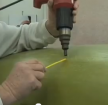
Continue Reading »Accuracy for hand drilled holes, not only with location, but also depth and vertical alignment are easily assured with drill and tap guides. In softer materials (ie, skis and snowboards) and using coarse threaded, alpine binding screws allow for minor adjustments and are a bit more forgiving than the accuracy required when drilling and tapping for screw inserts. Guides are still a good idea when drilling your precious boards for ANY binding mounts.
In addition to guides and correctly sized drill bits, drill bit and tap stops assure the proper depth of the drill hole and can also be used to make sure you do not strip the threads while tapping for screw or insert threads. Stepped drill bits (vs straight) offer a shoulder which can work as a ‘stop’ for experienced techs, but properly used bit stops are cheap insurance to help you avoid drilling through your ski or snowboard and can expedite the process.
Drill and tap guides can be used by simply holding them in place, but clamping is also a good idea, especially if you are less familiar or less confident about the procedure. Practice drill and tapping using the guides by hand and with clamps on scrap material before ‘learning by trial and error’ on your skis or snowboard.
Sometimes drill guides are described as ‘jigs’. This may cause confusion for some since binding jigs are made with set hole patterns for specific bindings. Guides need to be accurately placed using templates or other form of hole layout, are more versatile and have unlimited applications, including some with V-grooves that can be used on round materials (pipes, ski poles, bike tubing, etc) and corners.
SVST’s Drilling ‘Jig’ is a very nice adjustable drill guide for 5/16″ drill bits. Typical stepped alpine binding and insert mounting drill bits have a 5/16″ diameter shaft and the tips are milled at different diameters and lengths depending on the screw or insert application. The diameters required for alpine AB tap or insert taps are different than the 5/16′ drill bit.
Binding Freedom Drill and Tap Guide Block is used with ‘F’ (0.256″) or 1/4″ drill bits in one hole and a stainless steel insert tap, heli-coil tap and Binding Freedom’s 3 in 1 tool. It was designed to facilitate the drilling and tapping for installation of Binding Freedom stainless steel inserts. It can also be used for tap-in inserts, heli-coils and Quiver Killer stainless steel inserts.
The Wall-Lenk Drill Guide Kit has four bushings that fit into the square, plastic base with a V-groove. Also included is a center punch that can be used with the 3/16″ bushing to locate and then clamp or hold the guide at a desired location. The bushings can be used as tap guides but have a little play for a perfectly vertical tap alignment. Depending on tap stop diameter it may not allow for it’s use because the stop will not clear the top of the base’s sleeve and continue to the top of the bushing. Tapping with the stop by hand and not the base is an option. Tapping without the stop but with the bushing in the base is another option.
The Big Gator Tool V-Drill Guide offers 17 hole diameters in it’s v-grooved, metal base. The holes are a touch generous for perfectly aligned tapping, but work well enough for binding inserts and screws. Stops can be used on all taps and drills.
Continue Reading »